Your APS Bill Keeps Climbing. Your Usage Hasn't. Here's What's Actually Going On.
Your APS Bill Keeps Climbing. Your Usage Hasn't. Here's What's Actually Going On.
From Snowflake to Eagar, families are watching their power bills creep up and their lights flicker more often — and it has almost nothing to do with how much electricity they're using at home.
It's a hot afternoon in July. The air conditioner has been running most of the day, and when the well pump kicks on, the lights dim for a second before settling back. Nobody thinks much of it — it's just what summer feels like out here.
Then the power bill shows up, and it's higher than it was the month before. And the month before that. Nothing at home has changed — same family, same thermostat setting, same routine. So the obvious question is: if we're not using more electricity, why are we paying more for it?
So What Changed? (Hint: It's Not You)
A big part of the answer has nothing to do with any single household in Navajo County — it has to do with what's being built across Arizona's grid as a whole.
Some of the largest technology companies in the world are in the middle of an unprecedented buildout of AI data centers, and a meaningful share of that growth is landing in Arizona. By some industry estimates, four of the biggest U.S. tech companies alone are on pace to spend a combined $725 billion on AI infrastructure this year — a sharp jump from the year before. Those facilities don't run on their own power supply. They draw from the same regional grid that serves homes in Show Low, Snowflake, and everywhere in between.
You can see the effect directly in Arizona Public Service's own rate filing. APS has asked state regulators for an overall rate increase of roughly 16% — about $20 more per month for a typical home — and more than 45% more for its largest power users. In that same filing, APS has told regulators it expects peak electricity demand on its system to grow as much as 40% by 2031, and that data centers account for nearly all of the demand growth it has already seen in recent years. A decision from the Arizona Corporation Commission is expected by the end of 2026.
Figures above are drawn from APS's public rate case filing and industry/financial press reporting on 2026 AI infrastructure spending. The rate case is still under regulatory review and final numbers could change.
Why Rural Lines Feel It First
Homes out here aren't sitting on the same grid infrastructure as a subdivision in Phoenix. A lot of Navajo County runs on long rural distribution lines, sometimes with a single feed serving a whole stretch of road. When the broader grid comes under strain — whether from summer heat, equipment age, or simply more demand than the system was built for — those longer rural spurs tend to be among the first to see voltage sag, and often among the last restored when something does go down.
In Snowflake and Taylor, that shows up as well pumps and irrigation equipment that need a steady draw to run properly. In Shumway and White Mountain Lakes, smaller single-feed lines mean an outage in one spot can affect an entire area until a crew can get out and fix it. None of this is new, exactly — but as demand on the broader grid keeps climbing, the margin for error on these older rural lines keeps shrinking.
Taking Your Power Back
Arizona's data center buildout isn't slowing down, and neither is the demand it's putting on the grid. That part is largely out of any one homeowner's hands. What is in your control is where your own electricity comes from — and whether your monthly bill is tied to whatever the next rate case decides.
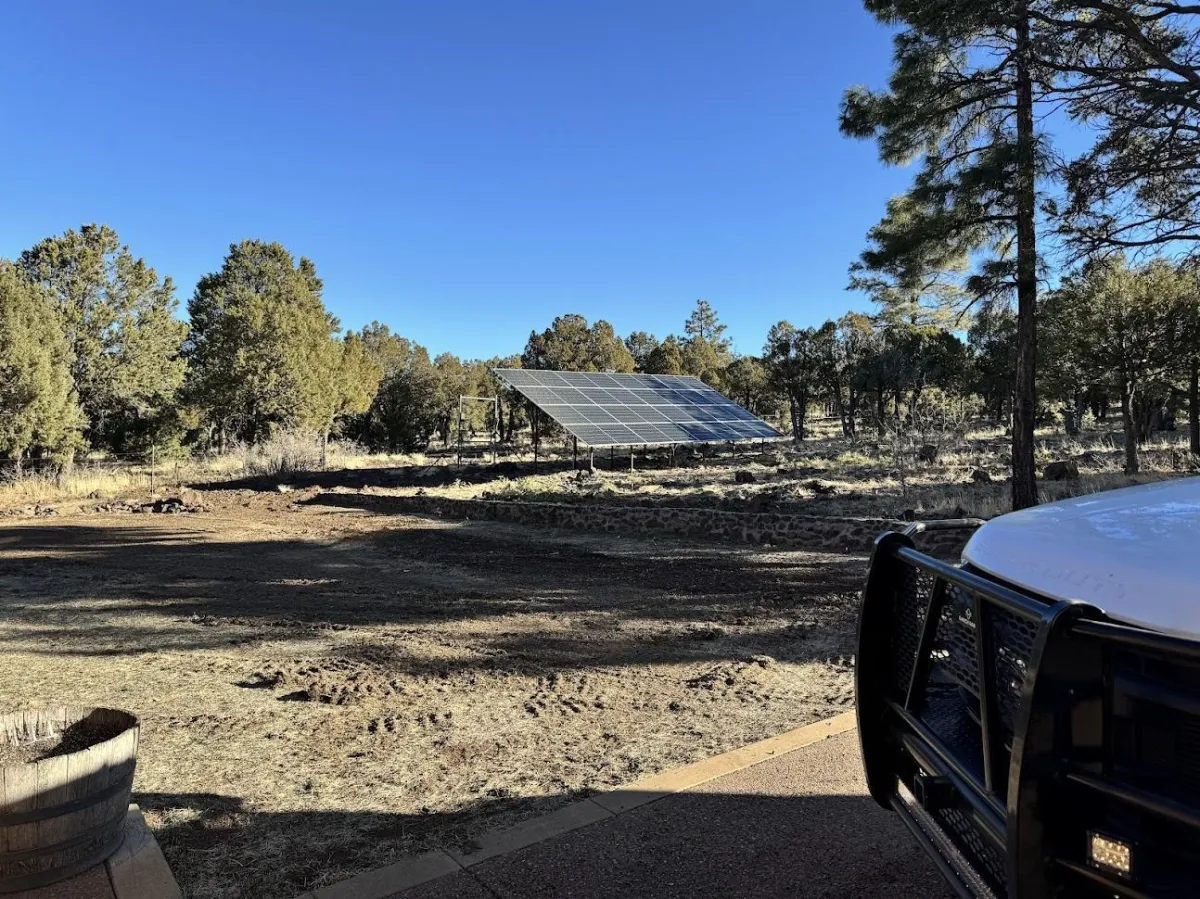
That's the piece we work on every day at White Mountains Solar. Every kit we sell is pre-built, pre-wired, and tested in our Show Low shop before it ever reaches your property — no guesswork, no surprises at install. Our 12kW EG4 system is the size that fits most homes in this area, and it's built to do two things at once: cut what you depend on the grid for, and keep your lights, well pump, and refrigerator running when the grid has a bad day.
12kW EG4 Solar Kit
A complete, expandable system sized for full-time Navajo County living — not a starter kit you'll outgrow.
| Inverter | 12,000W continuous, split-phase 120/240V |
| Battery storage | Expandable LiFePO4, 10-year warranty |
| Solar array | Up to 12kW (typically 24–30 panels) |
| Grid transfer time | Under 20ms — most homes never notice the switch |
| Operating modes | Hybrid, Grid-Tie, Full Off-Grid, Generator-Ready |
| Build | Pre-built, pre-wired, and tested in our Show Low shop |
